Uwharrie: A Midwinter Rite of Passage

Permalink to this nice article can be found here!

“Company” is a fickle, two-faced notion. To wit, the “more the merrier,” and “misery loves company.”

Perhaps it’s for both of these reasons the Uwharrie Mountain Runs have attracted such a ravenous following for two decades. The event offers athletes that rare opportunity to be miserable and joyous; to complain and celebrate simultaneously.

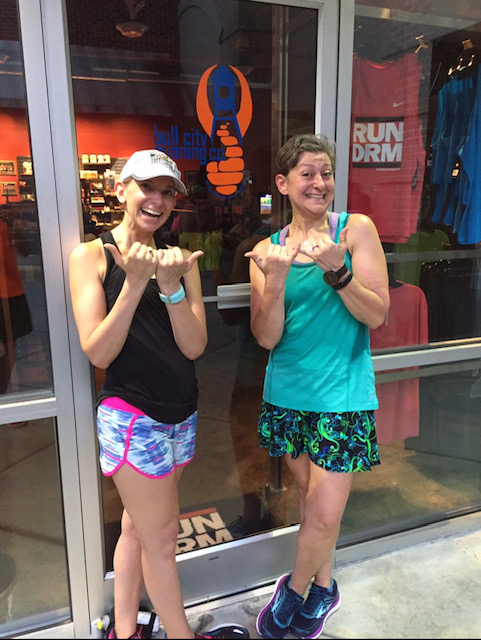
Staged near rual Ophir this past Saturday by Durham’s Bull City Running Company, the 20th annual Uwharrie Mountain Runs — rigorous 8-, 20- and 40-mile trail races — drew entrants from throughout the Southeast and beyond.

The off-road running Trailheads in Chapel Hill have virtually adopted the race as an annual rite of passage, and they treat Uwharrie as a fourth corner of the state’s Triangle region.

That fervor earned the Trailheads the team championship this past Saturday by way of five finishers among the top seven over the day’s three races — four of the top scorers being women.

The Trailheads (27 points) narrowly edged out Durham’s Bull City Running squad (30 points) and the Carolina Godiva Track Club (33 points), both of which are based in the Triangle.

But the races also drew hundreds from Central North Carolina who merely hoped to meet the challenge face-to-face.

“We’re still new to this — this is just our second year — but I think the race directors in previous years who are from this area really helped to cultivate a following,” said race director Kim Chapman, co-owner of Durham’s Bull City Running Company.

Ups and Downs

For the uninitiated, a pre-race warning that, “Yes, you will likely fall in the mud,” serves as an understatement. In years past, runners were told to run past mildly-injured runners “unless you see bones sticking out.”

Runners in all three races (staggered by one hour), ran just 100 yards of pavement before turning onto a single-track trail and ascending nearly 450 feet over the first three-quarters of a mile. Some charge up the hill; most take it as a conversational stroll — chattering away as if whistling in a graveyard. Toward the top, groups coalesce by pace, jackets are shed, quads ache, breathing quickens, and conversation wanes.

Rocks, roots, mud, calf-burning uphills, toe-crushing descents, and hip-deep stream crossings punish runners.

Weather can be changeable, and darkness can also creep up on 40-mile runners who are not allowed to venture past the 32-mile mark at 4 p.m. (nine hours into the race) without a headlamp.

Recent rain had turned the hilly trail particularly treacherous, and streams were swollen with run-off.

“Uwharrie is nothing if not an adventure,” said Chapman, who called it “hands-down the most logistically intensive event I’ve ever been a part of.”

Punctuating the same miles that topple and soak runners, smiling volunteers at aid stations every three miles dispensed well-deserved chocolate chip cookies, trail mix, sports drinks, potato chips and glowing encouragement that seemed to propel disheartened runners forward. At the finish lines, pottery awards crafted by Seagrove potter Michael Mahan awaited the winners.

Trailblazers

“I think the Uwharrie (National Forest) is one of the best-kept secrets in the area,” Chapman said. “It’s an amazing resource to have just an hour-and-a-half from the (Triangle’s) back door. I think there would be a lot of happy people if we expanded the race, but we have to protect that resource as well.”

In 1972, Scoutmaster Joe Moffit blazed the 20.5-miles of Uwharrie Trail for his Boy Scout troop. Today, Scouts still maintain the trail, including Roger “Edge” Halchin, leader of Troup 43 in Mebane, and a member of the Trailheads himself. The day before Uwharrie, Halchin brought supplies in to the starting area in support of the race.

“I did a reconnaissance trip in December (with other Trailheads) to find out where the trouble spots on the trail are,” Halchin said. “Then I did a trip here with my Scout troop to hike the trail and mark it with blazes.”

Trailheads

Halchin’s volunteer spirit was felt keenly on race weekend.

“This year, I brought four tents, one screen room, six tarps, a full kitchen with a coffeemaker, four two-burner stoves, a burner stand with a (large) pot,” added Halchin, who typically serves a finish-line dessert crisp that is worth running 20 miles for.

Halchin and Greg “Half Dome” Cordell put up the tents, said original Trailhead member Steven “Squonk” Hoge, who ran the 20-miler Saturday, “but the Trailheads also stocked the aid stations with volunteers.”

Bruce “Goofus” Wilks said the event has been sacrosanct since it first drew the attention of the Trailheads.

“It was probably eight or nine years ago that I first came down to run this in a big group,” Wilks said, “and we ran the eight (mile).”

“The best part for me is seeing those 40-milers finish,” Chapman said. “They’re just ecstatic.”

First-time 20-finisher Kevin Weeks said he was ready to sign up for 2012 just 20 minutes after finishing.

“I’m ready to get up at 8 a.m. on the next sign-up day for the next one,” he said. “It’s hard work, but … it was an amazing race.”

[Beautifully Written by Randy Young. All rights reserved. This copyrighted material may not be published, broadcast or redistributed in any manner.]
Posted in Uncategorized | Comments closed

Born to Run the Marathon?

It’s marathon season! Here’s a little reflection and inspiration for you from the NY Times Well Blog.

Link to article here. Full text below.

Even though I’m running better and farther now than I did in my 20s and have been researching, writing and talking about almost nothing but running, I’ve stayed away from the marathon. The distance wasn’t the problem. It was the event itself that bugged me.

Ten years ago, I quit running for good. I was sick of the constant injuries and dismissive shrugs of doctors who wondered, “Well, what did you expect?” One study found that up to 9 out of every 10 marathoners get hurt in training, so how many cortisone shots would it take before I got it through my head that it means something when a sport has a nearly 100 percent casualty rate? The human body wasn’t meant for all the pounding, the doctors kept telling me — especially not 230-pound bodies with nearly 40 years on the meter.

So I took their advice and tossed my Nikes, somehow missing the zoological weirdness in their diagnosis. I never thought to ask, “Hang on — if running is bad for humans, why isn’t it bad for every animal?” Dogs run on sidewalks, elephants trot for miles across baked African savannas, reindeer bound across solid ice on rock-hard hoofs, yet they don’t get shinsplints and Achilles tendinitis. How come every other creature gets along just fine on its own limbs except us?

It would be absurd if trout were at high risk for swimming injuries or 90 percent of blue jays tore their rotator cuffs from flying. Yet humans, who only had their feet for transportation for most of their existence, somehow arrived in the 21st century broken on delivery. Geronimo used to outrun cavalry horses and say, “You can only count on your legs. They’re your only friends.” So why are doctors telling me just the opposite?

In 2005, after years of exile from running, I discovered that Geronimo’s secret is still alive and well among the ultra-running Tarahumara Indians of Mexico’s Copper Canyons. I met their gringo protégé, “The White Horse,” and Daniel Lieberman, Harvard’s “Barefoot Professor,” and discovered that injury-free legs aren’t such a miracle after all. Within nine months, I transformed myself so completely that I was able to join the Tarahumara in a 50-mile race and haven’t missed a day of running due to injury ever since.

Since I told this story in my book “Born to Run,” I’ve been invited to speak at lots of marathons. And at every one of the pre-race dinners, I’d look down from the podium at people who’d handed over a month’s worth of grocery money to be there. They’d been herded through a maze of booths selling worthless and insanely overpriced running shoes, and would be crowded into buses the next morning and wait for hours penned up in corrals — corrals! like cattle! — before being released in waves, so many bodies they’re measured by oceanography — in exchange for…what, exactly?

If you want to run 26.2 miles, the door’s right there. Go. Why do you need corporate hoopla and 45,000 strangers along for the ride?

“I think mega-marathons pretty much epitomize everything that’s wrong with recreational running,” I recently e-mailed Dr. Lieberman, letting him know I’d decided to turn down an invitation to run this year’s New York City marathon with him.

His response was gentle and friendly, but boiled down to this: Get over yourself. What makes you so special that you can’t be part of “the world’s biggest peripatetic party,” as he put it. “Yeah, there is lots of commercialism, sponsors, hype — but to me these marathons are really more like festivals.”

And parties, essentially, are the centerpiece of Dr. Lieberman’s entire theory of human evolution. A big old running party, he believes, is what made our existence possible in the first place. Two million years ago, the brains of early humans dramatically increased in size, meaning they must have been eating other animals: in those pre-tofu, pre-Greek yogurt, pre-cultivated legume days, only flesh could provide enough condensed caloric energy to fuel that many brain cells. But the first spears and arrows only appeared about 200,000 years ago, so how were wimpy little Homo sapiens catching and killing prey without the benefit of claws, fangs, speed, strength or weapons?

Simple, Dr. Lieberman says. We’re really, really good at sweating. Our one natural advantage in the wild was our ability to vent heat by perspiration, instead of respiration. Let a horse run in the sun, and after a few panting miles it has a choice: breathe or cool off. It can’t do both at the same time, but we can. So he believes early humans formed into hunting parties and set off on hot days to chase bounding beasts into heat prostration, trotting along just fast enough to keep them on the move and out of the shade. But the crucial word isn’t “hunting,” but “party.” Try chasing a kudu on your own, and there will be two cadavers on the savanna.

That’s why we feel this urge to gather by the tens of thousands to surge through the city streets for an average of 4.5 hours — which, incidentally, is almost exactly how long it takes to run an antelope to death. You didn’t choose that distance; survival chose it for you.

But when I looked at today’s marathoners, I didn’t see a pack of brothers and sisters pulling together. I didn’t see communal spirit. I saw isolated, iPod-ed individualists more interested in their Garmins than each other. I saw commercial greed and egotistical obsessions over fractions of a minute.

And then I saw Derartu Tulu.

When she entered last year’s New York City marathon, Ms. Tulu was a 37-year-old has-been from Ethiopia who hadn’t won a marathon in eight years. Months earlier, she’d decided to retire. She hadn’t competed for two years after nearly dying in childbirth and was coming to realize she’d never regain the form that sped her to an Olympic gold medal nearly two decades before. But the limits of her aging body were complicated by the demands of a tender heart; in addition to her own two children, she’d adopted four orphans, and one last payday could guarantee her family’s security for a long time. She decided to go for it.

Unfortunately, so did the most formidable female marathoner in history: Paula Radcliffe, the world-record holder and three-time New York City champion. “Lean and mean,” the race announcers said in awe as they watched Ms. Radcliffe rocket off the starting line. “All the other athletes are so intimidated by this great champion. She’s the sharp end of this spear.”

But at mile 22 something strange happened, followed by something even stranger. Ms. Radcliffe grimaced and fell back. Her left hamstring had seized. It was the chance of a lifetime for Ms. Tulu — and she blew it. Instead of blazing toward the finish, she let the lead pack pass while she stopped and waited for Ms. Radcliffe.

“Come on,” she urged the lean, mean spear tip. “We can do it.”

Ms. Radcliffe tried, but her hamstring wouldn’t release. Ms. Tulu finally set off on her own. Somehow, she caught back up with the lead pack, and then the under-underdog blew past in the final quarter-mile to snap the tape. It’s among the most awe-inspiring performances I’ve ever seen, and to this day, I still don’t understand exactly what happened.

The best I can come up with is this: Maybe it wasn’t a coincidence that one of the most compassionate people on the streets that day was also the most competitive. The greatness of spirit which urged her to watch for every faltering orphan, to keep the pack together, also gave her the strength to lead it. At its finest and most time-tested, after all, running was never a solitary pursuit. The Tarahumara don’t compete individually, preferring instead to kick-flip a small wooden ball from teammate to teammate, maintaining a constellation of flowing bodies. The Hopi believed running was a form of prayer; before setting off on a long run from Arizona to the Pacific, they’d offer their effort on behalf of loved ones in need of help. “I’m offering my strength to them,” the runner would murmur to their god, the Great Mystery, “and in return I ask for some of yours.”

I sent Dr. Lieberman another message. “I’m in.”

The real tragedy of the mega-marathon wasn’t too much hype and too many marathoners, but too little and too few. Luckily, the message has recently begun spreading that running can be easy and gentle and injury free, meaning lots more people may soon be joining the party that started them all.

Christopher McDougall is the author of “Born to Run: A Hidden Tribe, Super Athletes, and The Greatest Race the World Has Never Seen.” This Friday, Nov. 5, he’ll host Dr. Lieberman and other speakers in “Running Reinvented: The Cabaret,” at the Society for Ethical Culture on 2 West 64th Street in New York City at 6:30 p.m.

Posted in Uncategorized | Comments closed

How to Push Past the Pain

October 18, 2010 (NY Times)

How to Push Past the Pain, as the Champions Do

By GINA KOLATA

My son, Stefan, was running in a half marathon in Philadelphia last month when he heard someone coming up behind him, breathing hard.

To his surprise, it was an elite runner, Kim Smith, a blond waif from New Zealand. She has broken her country’s records in shorter distances and now she’s running half marathons. She ran the London marathon last spring and will run the New York marathon next month.

That day, Ms. Smith seemed to be struggling. Her breathing was labored and she had saliva all over her face. But somehow she kept up, finishing just behind Stefan and coming in fifth with a time of 1:08:39.

And that is one of the secrets of elite athletes, said Mary Wittenberg, president and chief executive of the New York Road Runners, the group that puts on the ING New York City Marathon. They can keep going at a level of effort that seems impossible to maintain.

“Mental tenacity — and the ability to manage and even thrive on and push through pain — is a key segregator between the mortals and immortals in running,” Ms. Wittenberg said.

You can see it in the saliva-coated faces of the top runners in the New York marathon, Ms. Wittenberg added.

“We have towels at marathon finish to wipe away the spit on the winners’ faces,” she said. “Our creative team sometimes has to airbrush it off race photos that we want to use for ad campaigns.”

Tom Fleming, who coaches Stefan and me, agrees. A two-time winner of the New York marathon and a distance runner who was ranked fourth in the world, he says there’s a reason he was so fast.

“I was given a body that could train every single day.” Tom said, “and a mind, a mentality, that believed that if I trained every day — and I could train every day — I’ll beat you.”

“The mentality was I will do whatever it takes to win,” he added. “I was totally willing to have the worst pain. I was totally willing to do whatever it takes to win the race.”

But the question is, how do they do it? Can you train yourself to run, cycle, swim or do another sport at the edge of your body’s limits, or is that something that a few are born with, part of what makes them elites?

Sports doctors who have looked into the question say that, at the very least, most people could do a lot better if they knew what it took to do their best.

“Absolutely,” said Dr. Jeroen Swart, a sports medicine physician, exercise physiologist and champion cross-country mountain biker who works at the Sports Science Institute of South Africa.

“Some think elite athletes have an easy time of it,” Dr. Swart said in a telephone interview. Nothing could be further from the truth.

And as athletes improve — getting faster and beating their own records — “it never gets any easier,” Dr. Swart said. “You hurt just as much.”

But, he added, “Knowing how to accept that allows people to improve their performance.”

One trick is to try a course before racing it. In one study, Dr. Swart told trained cyclists to ride as hard as they could over a 40-kilometer course. The more familiar they got with the course, the faster they rode, even though — to their minds — it felt as if they were putting out maximal effort on every attempt.

Then Dr. Swart and his colleagues asked the cyclists to ride the course with all-out effort, but withheld information about how far they’d gone and how far they had to go. Subconsciously, the cyclists held back the most in this attempt, leaving some energy in reserve.

That is why elite runners will examine a course, running it before they race it. That is why Lance Armstrong trained for the grueling Tour de France stage on l’Alpe d’Huez by riding up the mountain over and over again.

“You are learning exactly how to pace yourself,” Dr. Swart said.

Another performance trick during competitions is association, the act of concentrating intensely on the very act of running or cycling, or whatever your sport is, said John S. Raglin, a sports psychologist at Indiana University.

In studies of college runners, he found that less accomplished athletes tended to dissociate, to think of something other than their running to distract themselves.

“Sometimes dissociation allows runners to speed up, because they are not attending to their pain and effort,” he said. “But what often happens is they hit a sort of physiological wall that forces them to slow down, so they end up racing inefficiently in a sort of oscillating pace.” But association, Dr. Raglin says, is difficult, which may be why most don’t do it.

Dr. Swart says he sees that in cycling, too.

“Our hypothesis is that elite athletes are able to motivate themselves continuously and are able to run the gantlet between pushing too hard — and failing to finish — and underperforming,” Dr. Swart said.

To find this motivation, the athletes must resist the feeling that they are too tired and have to slow down, he added. Instead, they have to concentrate on increasing the intensity of their effort. That, Dr. Swart said, takes “mental strength,” but “allows them to perform close to their maximal ability.”

Dr. Swart said he did this himself, but it took experience and practice to get it right. There were many races, he said, when “I pushed myself beyond my abilities and had to withdraw, as I was completely exhausted.”

Finally, with more experience, Dr. Swart became South Africa’s cross-country mountain biking champion in 2002.

Some people focus by going into a trancelike state, blocking out distractions. Others, like Dr. Swart, have a different method: He knows what he is capable of and which competitors he can beat, and keeps them in his sight, not allowing himself to fall back.

“I just hate to lose,” Dr. Swart said. “I would tell myself I was the best, and then have to prove it.”

Kim Smith has a similar strategy.

“I don’t want to let the other girls get too far ahead of me,” she said in a telephone interview. “I pretty much try and focus really hard on the person in front of me.”

And while she tied her success to having “some sort of talent toward running,” Ms. Smith added that there were “a lot of people out there who were probably just as talented. You have to be talented, and you have to have the ability to push yourself through pain.”

And, yes, she does get saliva all over her face.

“It’s not a pretty sport,” Ms. Smith said. “You are not looking good at the end.”

As for the race she ran with my son, she said: “I’m sorry if I spit all over Stefan.” (She didn’t, Stefan said.)

Posted in Uncategorized | Comments closed

Pay It Forward

A big, big thanks to all of the Bull City folks who came out to pay it forward at the Habitat house last Saturday! Special thanks to Gene Oddone and Grace Couchman for coordinating this great effort and hosting us for dinner after a hot afternoon of painting!

Posted in Uncategorized | Comments closed

Zion National Park Traverse

[Editor's note: Thanks to guest blogger and local ultra enthusiast, Meredith Barrett, for this awe-inspiring run report!]

Red Rocks. Steep canyon walls. 48 miles of trail. On your own. Who’s in?
A great friend of mine took me aside about a year ago and innocently inquired, “So what if I asked you to run an ultramarathon across Zion National Park with me? Would you think I was crazy?” Yes, I would, but somehow she convinced a few of us to do it with her—a 48 mile trail run across Zion, unsupported, just 5 women (four ecologists and 1 glaciologist-turned-medic). She had been completely sold on this run idea after seeing stunning pictures and videos from Andrew Skurka—an ultrarunner and outdoor adventurer extraordinaire—who is one of the few people to have finished  this traverse before. Our team had all finished marathons in the past, but this was going to be the first big ultrarun for most of us. We picked a date, bought plane tickets and then we were locked in. No going back!

From December to April, each of us followed a training plan combined and modified from Runners World and Hal Higdon. We relied on the theory that if you run back-to-back days (e.g., 25 miles Saturday, 13 miles Sunday), then your body responds as though it’s running longer (>40 miles), but without all the injuries. We each battled with minor injuries during training (tight Achilles tendons, some knee pain, some hip pain), but when April arrived, we were all healthy enough and ready to go!

Vegas, baby, yeah!
Las Vegas served as our meeting and prepping point. No time for a “Thunder from Down Under” show, but we did appreciate the opportunity to stock up on enough food to feed an army. And then we were off to Zion!
The trail
You can see why Zion was protected as one of our country’s first National Parks. Its stunning canyons, slabs of open sandstone, distinctive red and white cliff bands and lush river corridors made for a fantastic distraction from the pain in our legs over the long miles of this run. We ran from the East Rim trailhead to Lee Pass—a route that crosses across some of the most dramatic Zion country, gaining 10,000 feet and then losing just about the same over 48.3 miles (see map—SE corner to NW corner).

Andrew Skurka’s website is a wonderful resource for anyone planning to do this run. Skurka recommends running this route in late April, when the snows have melted but before it gets too hot for those open, exposed stretches of trail. Thinking we were perfectly on target, we chose a weekend in late April to hit that peak time. Who knew it was also going to be an El Nino year? Nature had different ideas in store, and Zion had a heavy winter, getting hit with 170% more precipitation than normal. When we finally were able to talk with a backcountry ranger on the phone, he explained “Well, no one has actually been over that section of trail yet this season, so we have no idea how much snow is out there. Could be deep!” We battled with the decision of what to do with this new information–do we alter our route?  Skip that section? Run with snowshoes? Get a heli drop? We had been training for so long, and had set our hearts on finishing this route, so we decided to do what probably many crazy ultrarunners would do—we decided to just go for it. If we had to turn back mid-route, so be it. So with that uncertainty and a bit more nervousness, we got ready for anything Zion might throw at us.

After several hours of last minute purchasing (what a good excuse to buy new gear!), food prepping (enough to feed an army) and carbo-loading (awesome local pasta shop), we were ready and nervous to start our big day. A sister of one of our team and her friend had very generously offered to be our support crew for the day—we could not have done it without them!

East Rim Trailhead to the Grotto (~Miles 1 – 12)
We drove to the East Rim trailhead early in the morning, playing energetic music all the way to pump ourselves up and ease those nerves. Still dark at the trailhead at 6am, we started our route happily at a slow jogging pace, wary of any hidden rocks along the trail unseen with our headlamps.

As the sun rose, we began to see more clearly the beauty of the landscape around us. A light dusting of snow and sparkling of ice on the vegetation gave it a magical quality. The first stretch was a bit cold, but enjoyable and beautiful in the misty clouds.

We emerged into red rock country and loved the chance to run right through a small slot canyon.

From here we looked down upon the Zion Canyon and the North Fork of the Virgin River, and then proceeded to switchback all the way down to the road to reach the Grotto, our first support stop, at about 12 miles in.

Don’t we still look energized and happy?
The Grotto to the Top of the West Rim (Miles 12 – 16)
After loading up on PB&J’s, water, bananas, oranges, sesame sticks (salty and delicious) and “speed balls” (aka chocolate covered espresso beans, our savior!) we started the steep ascent up to the top of the West Rim. After crossing the North Fork of the Virgin River, the trail—blasted into the rock and surprisingly paved in some parts—climbs quickly and then switchbacks up to the start of the famous Angel’s Landing climb.

Looking back down to Zion Canyon…

The trail and its endless switchbacks are blasted into the rock.

We crossed long sandstone slabs and then continued the climb up to the Rim.

Along the West Rim (~Miles 16 – 35ish)

We happily reached the West Rim, but ran into what we feared, yet knew, would be there. Snow. For about 10 miles we ran through patches of the stuff, which made it difficult to follow the trail. The glaciologist/medic (what a great combo!) member of our team has spent most of her professional career in the backcountry, so she easily guided us through the covered sections.

Our strategy for the entire run had been to keep a steady, consistent pace on the flat and downhill sections and then to walk briskly up the steep hills. Walking uphill actually conserves more energy than running slowly, and we wanted to save every drop of energy that we had. This strategy worked really well until we hit these snowy parts, where it was impossible to keep up a consistent running pace even in the flat stretches.

I have to say that mud is much worse than snow. One step forward, then we’d slip almost all the way back. That’s no way to make progress on an ultrarun!

The snow got deep in some sections and we post-holed our way through it. After several hours of this slow progress, and a bit of trail searching after we went off-trail, we reached a decision point. Do we continue to slog through the snow on hidden trails in the dark? The sunlight was waning, we were all drinking melted snow for water, and after 11 hours of hard work we decided to alter our route slightly and attempt to meet up with our support crew.  We had two options—try to follow the faint trail that was covered in 3 feet of snow, or head out on a snow-covered road that would take us to the same point. The road would be much easier to spot and follow, so we decided to take the safer route.

We emerged into a beautiful snowy field and then headed down the road. Nine miles later (at a total of about 35-38 miles) we met up with our savior support crew, who hailed us with fresh water, warm clothes and beef jerky!

The tired, yet happy, crew at the end of a long day.

Coming back for more (~Miles 35 – 48)
We woke up the next morning feeling tired and happy, but not quite satisfied. We had dreamed for months about finishing this run across Zion, and our determination got the better of us. Instead of soaking our legs in the cold waters of the Virgin River, drinking well-deserved margaritas, we decided to polish off the last unfinished section of the run, from Hop Valley Trailhead to Lee’s Pass, which is about 13 miles. We feared snow, we feared mud, but decided to go for it anyways. What we found was one of the most beautiful and friendly stretches of trail that we had run all trip. We wound through small, intimate red rock canyons, crossed flowing streams and a rushing La Verkin River, passed through gorgeous private ranches and marveled at the stunning scenery all around us. THIS was what running across Zion was all about! It washed away any of the frustration from the difficult snow-slogging of the day before.

Crossing La Verkin River.

With the moon rising and the red color of the rocks coming into full flush, we made it to Lee Pass.  It was an amazing and challenging trip, and we were all so happy to have been healthy enough to attempt it. It took a little longer than we planned, but we did it! I feel confident that all of us would have made it across the Park in one day had the conditions cooperated. And maybe we’ll get our chance—we’re raring to do it again!

Running an ultramarathon through such a stunning place, and with such great friends, was an experience of a lifetime. If you’re thinking about it, go for it!

A little post-run celebration in the hot tub (ahhh…..).

Thanks to Bull City Running Company for outfitting me for this race! The Body Glide was ESSENTIAL!

Resources:
Great information about the route can be found on Andrew Skurka’s website:
http://www.andrewskurka.com/RACE/ZION/index.php

Trip section maps (copied from an excellent trip report from one of the original runners of this route):
http://adventurerun.wordpress.com/2008/05/26/zion-traverse/

Posted in Uncategorized | Comments closed

Darn Tough Testimony

Ask and you shall receive ;)
Darn Tough socks have arrived and they come with a lifetime warranty. Can’t beat that!

Here is the request/impassioned plea that put it all in motion:

I was in the shop last week, and Jason set me up in a pair of Crosslites which I’m loving (definitely the most comfortable upper I’ve ever worn) and wishing I’d had them for the Uwharrie20. So thanks for that, but this note is to unashamedly beg you to start carrying Darn Tough socks. Really, no kidding, I’m outright begging and even have a little tear in my eye while I’m typing this note in hopes that you’ll sell me more of these socks.

I was on the Thirsty Thursday run when Tres demo’d the Mountain Masochists and also gave away some DT socks. I unsuspectingly took a pair since I’d never worn any type of wool gear (cycling/running jerseys, socks, nothing) and I figured a free pair would be the best way to confirm whether they would itch once I started sweating in them (which I had always assumed). Now I’ve become completely addicted to these socks and am resorting to wearing this one pair embarrassingly often and in conditions that repulse our dog and definitely wouldn’t pass Health Codes if I were a restaurant worker (e.g. a 40-hour stint of continuous wear that included two long, muddy trail runs, 2-ish days of casual wear and an overnight of sleeping in them — I’m not proud, and I fully admit that I’ve fallen a long way from basic human standards when it comes to these socks, but it’s not all my fault as I’ll explain below).

To confirm what I’m up against and that I’m not the only one in this pickle (and that I’m confident you’ll sell plenty of these socks once you start carrying them), I described my struggle to a friend in Boise, ID, who had mentioned Darn Tough socks some time ago. I told him how I hate to take them off and that I really only remove them when my wife demands them from me in order to wash them in the SuperAggressive washer cycle that usually includes most of my other running clothes, but that I promptly yank them from the dryer to get them back onto my feet pronto. He understood immediately and empathized since he had experienced the same addiction issues when he innocently came across DT socks at a local outdoor shop and wore them so continuously that he wore a hole in the heel, sent them back to Darn Tough for replacements (awesome guarantee), then wore those out as well while also somehow turning all his toes bright red (something his doctor described as “chronic excessive continuum of abrasive exposure to fine merino wool syndrome”, commonly known as “DT-itis”). He had to quit DTs cold turkey for nearly a year until he could resume a 12-step program of gradually reintroducing them into his wear cycle. Now he’s doing fine and has adjusted to wearing a more typical variety of socks, but he’ll always be a recovering DT-holic and is very worried about me and the slippery slope I’m undeniably on.

Clearly Bull City Running is partly (even mostly) to blame for my DT cravings and sad hygienic predicament since it introduced me to these socks but now won’t feed my pathetic jonesing since I’m limited to this one overwhelmed pair from Tres. In this case, the drug dealer-like “first one’s free” method of introducing a product to a naive customer has unquestionably produced a fast convert-turned-addict, but unlike Crack I can’t get any more DT socks from my Dealer. Makes me wonder if my “DT” abbreviation might also imply the dreadfully uncomfortable DeTox I’ll be going through if I don’t find a source soon for more Run/Bike No-Show Cushion #1416 socks in Light Grey, Natural and/or Black (just in case Tres didn’t tell you exactly what he pulled out of his goodie bag that evening).
If I don’t find a solution soon, I anticipate the Trailheads periodically coming across me lurching aimlessly and wide-eyed through CNF while wearing a pair of Crosslites and exceptionally tattered Darn Tough socks and mumbling gibberish about Bull City Running, one single pair of DTs, a once-happy, mainstream life and a rapid collapse after a seemingly innocent demo run with a sock rep.

Respectfully (but in kind of a desperate, demanding way),
-Michael Baucom

PS — So really, will you please start carrying them??

Posted in Uncategorized | Comments closed

Bracket Buster 5K

Does anyone out there still have a viable bracket?
Thanks to those who came out for the free fun run on Sunday afternoon! Results from the Bracket Buster 5K are posted here!

Special thanks to Mike at Starbucks in Southpoint Crossing for the coffee and to Jordan from CRAFT/Karhu for being a part of the festivities and giving folks an opportunity to win a trip to Finland!

Now…onto the NIT Tournament. Go Heels! :)

Posted in Uncategorized | Comments closed

Masochist vs. Wildcat

If you were a shoe, what would you be?

The jury is in for one local trail enthusiast! The following shoe review is compliments of veteran trail-runner and passionate nature-lover, Steve “Squonk” Hoge of the Trailheads who recently went heel-to-toe with the Montrail Masochist and La Sportiva Wildcat:

Yo,
I had back to back long(ish) runs last weekend. 15 miles in the Wildcats Saturday and 10 in the Masochists on Sunday. On Sunday I may or may not have imagined that the new Montrails were spongier and more flexible than the La Sportivas.

I kept the Masochists on for Tuesday and Wednesday and think it’s definitely a better shoe for me. Still some tendonitis, but that’s not a shoe thing; it’s a me thing.

The Masochists remind me of the old Highlander which held up well for 50K distance, but fell short of comfortable (relative) for 50 milers. But I’m thinking the new design, with added cushioning (not too much, but just about right) may become my shoe for the remainder of the year.

So, there you have it (but we know he still has plenty of love for La Sportiva). It is also worth noting that our guest blogger/shoe reviewer is also the acclaimed inventor, manufacturer, and distributor of the SportSlipper (and he may be looking for an angel investor). Both Montrail and La Sportiva models are currently available.

Posted in Uncategorized | Comments closed

Green Silence

Myong, A faithful runner and friend to Bull City Running Co. logged 14 miles in her new Brooks Green Silence last weekend. She says that she is definitely using them to race in next week at the Myrtle Beach Half Marathon. The Green Silence is a super flexible eco-friendly shoe that works well as a racing flat or a lightweight trainer for runners who do not require a lot of support. We were thrilled to get early feedback on this very intriguing new shoe from Brooks.

Go Myong and all our other friends who are headed to Myrtle Beach the weekend of February 12-14!

Posted in Uncategorized | Comments closed

Healing or Stealing?

Editors note: On the surface, this may not appear to be running related. But it is: it is about life, appreciation and preservation of the Earth, and the role each of us can play. Plus, it’s a nice shot of inspiration for your day.

The Unforgettable Commencement Address of 2009.

By Paul Hawken

When I was invited to give this speech, I was asked if I could give a simple short talk that was “direct, naked, taut, honest, passionate, lean, shivering, startling, and graceful.” No pressure there.

Let’s begin with the startling part. Class of 2009: you are going to have to figure out what it means to be a human being on earth at a time when every living system is declining, and the rate of decline is accelerating. Kind of a mind-boggling situation… but not one peer-reviewed paper published in the last thirty years can refute that statement. Basically, civilization needs a new operating system, you are the programmers, and we need it within a few decades.

This planet came with a set of instructions, but we seem to have misplaced them. Important rules like don’t poison the water, soil, or air, don’t let the earth get overcrowded, and don’t touch the thermostat have been broken. Buckminster Fuller said that spaceship earth was so ingeniously designed that no one has a clue that we are on one, flying through the universe at a million miles per hour, with no need for seatbelts, lots of room in coach, and really good food—but all that is changing.

There is invisible writing on the back of the diploma you will receive, and in case you didn’t bring lemon juice to decode it, I can tell you what it says: You are Brilliant, and the Earth is Hiring. The earth couldn’t afford to send recruiters or limos to your school. It sent you rain, sunsets, ripe cherries, night blooming jasmine, and that unbelievably cute person you are dating. Take the hint. And here’s the deal: Forget that this task of planet-saving is not possible in the time required. Don’t be put off by people who know what is not possible. Do what needs to be done, and check to see if it was impossible only after you are done.

When asked if I am pessimistic or optimistic about the future, my answer is always the same: If you look at the science about what is happening on earth and aren’t pessimistic, you don’t understand the data. But if you meet the people who are working to restore this earth and the lives of the poor, and you aren’t optimistic, you haven’t got a pulse. What I see everywhere in the world are ordinary people willing to confront despair, power, and incalculable odds in order to restore some semblance of grace, justice, and beauty to this world. The poet Adrienne Rich wrote, “So much has been destroyed I have cast my lot with those who, age after age, perversely, with no extraordinary power, reconstitute the world.” There could be no better description. Humanity is coalescing. It is reconstituting the world, and the action is taking place in schoolrooms, farms, jungles, villages, campuses, companies, refuge camps, deserts, fisheries, and slums.

You join a multitude of caring people. No one knows how many groups and organizations are working on the most salient issues of our day: climate change, poverty, deforestation, peace, water, hunger, conservation, human rights, and more. This is the largest movement the world has ever seen. Rather than control, it seeks connection. Rather than dominance, it strives to disperse concentrations of power. Like Mercy Corps, it works behind the scenes and gets the job done. Large as it is, no one knows the true size of this movement. It provides hope, support, and meaning to billions of people in the world. Its clout resides in idea, not in force. It is made up of teachers, children, peasants, businesspeople, rappers, organic farmers, nuns, artists, government workers, fisherfolk, engineers, students, incorrigible writers, weeping Muslims, concerned mothers, poets, doctors without borders, grieving Christians, street musicians, the President of the United States of America, and as the writer David James Duncan would say, the Creator, the One who loves us all in such a huge way.

There is a rabbinical teaching that says if the world is ending and the Messiah arrives, first plant a tree, and then see if the story is true. Inspiration is not garnered from the litanies of what may befall us; it resides in humanity’s willingness to restore, redress, reform, rebuild, recover, reimagine, and reconsider. “One day you finally knew what you had to do, and began, though the voices around you kept shouting their bad advice,” is Mary Oliver’s description of moving away from the profane toward a deep sense of connectedness to the living world.

Millions of people are working on behalf of strangers, even if the evening news is usually about the death of strangers. This kindness of strangers has religious, even mythic origins, and very specific eighteenth-century roots. Abolitionists were the first people to create a national and global movement to defend the rights of those they did not know. Until that time, no group had filed a grievance except on behalf of itself. The founders of this movement were largely unknown — Granville Clark, Thomas Clarkson, Josiah Wedgwood — and their goal was ridiculous on the face of it: at that time three out of four people in the world were enslaved. Enslaving each other was what human beings had done for ages. And the abolitionist movement was greeted with incredulity. Conservative spokesmen ridiculed the abolitionists as liberals, progressives, do-gooders, meddlers, and activists. They were told they would ruin the economy and drive England into poverty. But for the first time in history a group of people organized themselves to help people they would never know, from whom they would never receive direct or indirect benefit. And today tens of millions of people do this every day. It is called the world of non-profits, civil society, schools, social entrepreneurship, non-governmental organizations, and companies who place social and environmental justice at the top of their strategic goals. The scope and scale of this effort is unparalleled in history.

The living world is not “out there” somewhere, but in your heart. What do we know about life? In the words of biologist Janine Benyus, life creates the conditions that are conducive to life. I can think of no better motto for a future economy. We have tens of thousands of abandoned homes without people and tens of thousands of abandoned people without homes. We have failed bankers advising failed regulators on how to save failed assets. We are the only species on the planet without full employment. Brilliant. We have an economy that tells us that it is cheaper to destroy earth in real time rather than renew, restore, and sustain it. You can print money to bail out a bank but you can’t print life to bail out a planet. At present we are stealing the future, selling it in the present, and calling it gross domestic product. We can just as easily have an economy that is based on healing the future instead of stealing it. We can either create assets for the future or take the assets of the future. One is called restoration and the other exploitation. And whenever we exploit the earth we exploit people and cause untold suffering. Working for the earth is not a way to get rich, it is a way to be rich.

The first living cell came into being nearly 40 million centuries ago, and its direct descendants are in all of our bloodstreams. Literally you are breathing molecules this very second that were inhaled by Moses, Mother Teresa, and Bono. We are vastly interconnected. Our fates are inseparable. We are here because the dream of every cell is to become two cells. And dreams come true. In each of you are one quadrillion cells, 90 percent of which are not human cells. Your body is a community, and without those other microorganisms you would perish in hours. Each human cell has 400 billion molecules conducting millions of processes between trillions of atoms. The total cellular activity in one human body is staggering: one septillion actions at any one moment, a one with twenty-four zeros after it. In a millisecond, our body has undergone ten times more processes than there are stars in the universe, which is exactly what Charles Darwin foretold when he said science would discover that each living creature was a “little universe, formed of a host of self-propagating organisms, inconceivably minute and as numerous as the stars of heaven.”

So I have two questions for you all: First, can you feel your body? Stop for a moment. Feel your body. One septillion activities going on simultaneously, and your body does this so well you are free to ignore it, and wonder instead when this speech will end. You can feel it. It is called life. This is who you are. Second question: who is in charge of your body? Who is managing those molecules? Hopefully not a political party. Life is creating the conditions that are conducive to life inside you, just as in all of nature. Our innate nature is to create the conditions that are conducive to life. What I want you to imagine is that collectively humanity is evincing a deep innate wisdom in coming together to heal the wounds and insults of the past.

Ralph Waldo Emerson once asked what we would do if the stars only came out once every thousand years. No one would sleep that night, of course. The world would create new religions overnight. We would be ecstatic, delirious, made rapturous by the glory of God. Instead, the stars come out every night and we watch television.

This extraordinary time when we are globally aware of each other and the multiple dangers that threaten civilization has never happened, not in a thousand years, not in ten thousand years. Each of us is as complex and beautiful as all the stars in the universe. We have done great things and we have gone way off course in terms of honoring creation. You are graduating to the most amazing, stupefying challenge ever bequested to any generation. The generations before you failed. They didn’t stay up all night. They got distracted and lost sight of the fact that life is a miracle every moment of your existence. Nature beckons you to be on her side. You couldn’t ask for a better boss. The most unrealistic person in the world is the cynic, not the dreamer. Hope only makes sense when it doesn’t make sense to be hopeful. This is your century. Take it and run as if your life depends on it.

[The original speech appears here.]

Posted in Uncategorized | Comments closed
  • Upcoming Events

    See YOUR LOCAL BULL SHEET for details and to RSVP for any event below!

    SPRING APPAREL SALE!
    25% off all in-stock spring apparel and sports bras!

    Running of the Bulls 8K
    June 1st @ Durham Athletic Park
    Register Today!
    Join us for Durham's 5th annual premiere community road race!

    Fullsteam Ahead! Run Club
    Every Wednesday @ 6PM.
    All paces welcome!

  • Store Info

    Hours:
    M-T-W: 10a-6p
    Th-F: 10a-7p
    Sa: 10a-6p
    Su: 12p-5p

    Phone: 919.265.3904
    Email: bullcityrunning@gmail.com
    Address (Map):
    Southpoint Crossing
    202 W NC Highway 54, Suite 201
    Durham, NC 27713

  • Follow Along!
  • Newsletter Sign up